
Heatwaves Caused by Fall in Pollution? Not really...
What a study on European warming actually found and how it got twisted into a climate-denial talking point.

The Telegraph ran a piece titled Heatwaves caused by fall in pollution this week, and we can safely say the word “caused” is doing an awful lot of heavy lifting here.
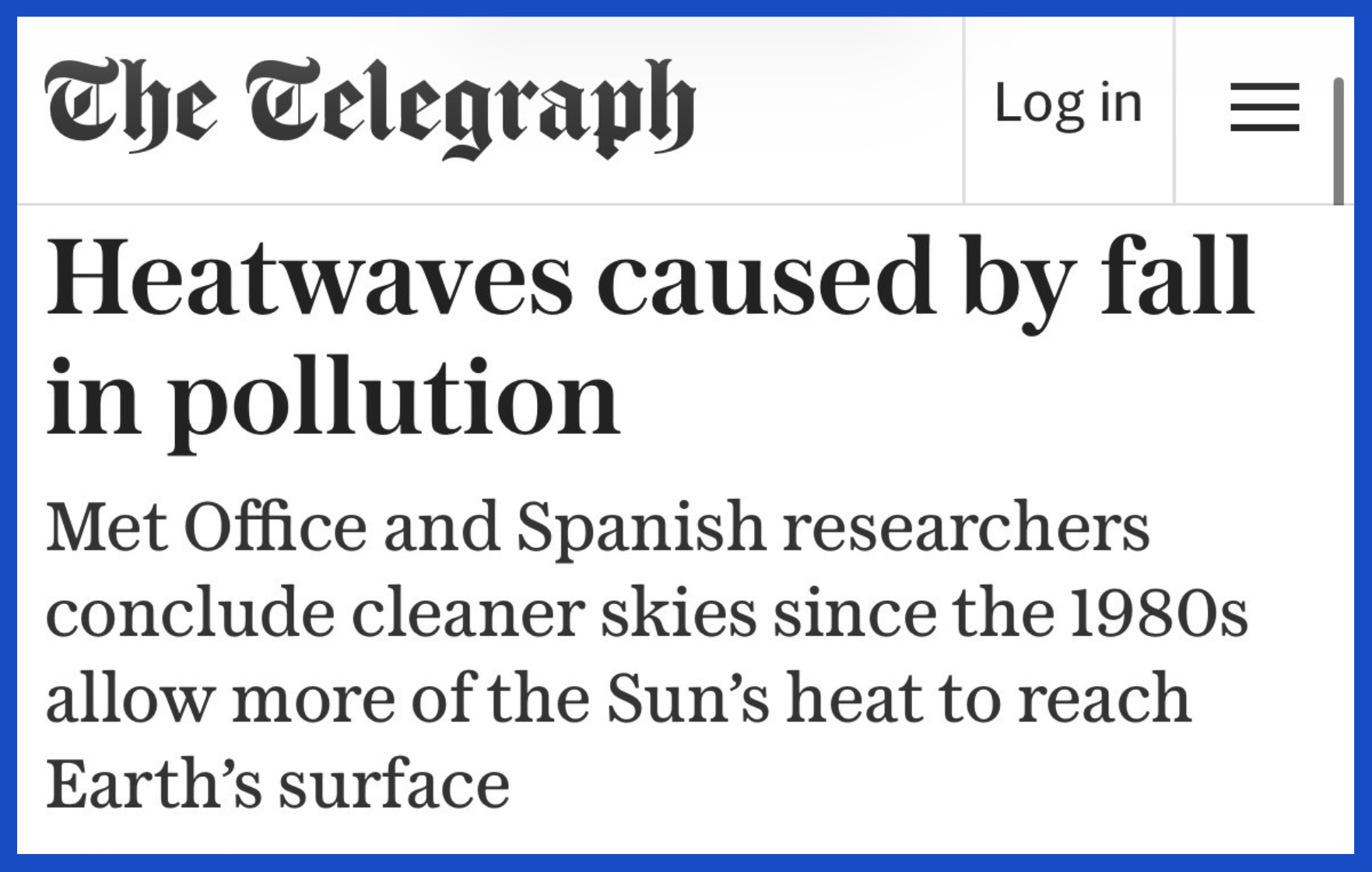
The Telegraph was reporting on a research paper published in the Geophysical Research Letters journal, which looked at the impact of aerosols on European summer temperatures.
Let’s have a look at what the research actually showed and, importantly, why the research was done.
The Research
While we know the Earth’s climate is warming due to man-made climate change, we also know that a lot of individual factors can feed into the rate of warming globally and locally.
One of the factors impacting temperatures on the Earth’s surface is particles in the atmosphere.
I discussed this in last year’s two-parter looking at the claims that the British government were “dimming the sun”.


From part 2:
Scientists had noticed that the clouds above shipping lanes were much brighter than elsewhere, and that this had a cooling effect below them. But when new regulations limiting the amount of Sulphur dioxide allowed in ships’ emissions came into force, the clouds became less bright, which led to an increase in temperature.
Basically, particles caused by burning fossil fuels, such as Sulphur dioxide, can go up into the atmosphere, where they reflect sunlight back away from the Earth’s surface, cooling the Earth below.
The research paper in question in this Telegraph article examined the impact of reducing air pollution in Europe from the 1980s onwards on our temperatures.
In particular, it wanted to answer the question of why temperatures in Europe have been increasing at a faster rate than much of the rest of the world - Europe is currently 2.3oC warmer than it was in the pre-industrial era, while the global average is 1.3oC - and why earlier climate models failed to predict this phenomenon.
They found that policies implemented to tackle air pollution in Europe reduced the amount of aerosols, such as sulphates, in the atmosphere, and, like with the shipping lanes mentioned above, this led to more of the sun’s energy reaching the ground rather than being reflected back out of the atmosphere.
The air pollution had been acting like a sunshade across Europe, and as it has been reduced in the last few decades, so have the shading effects.
This has not only predictably heated Europe more directly, but it has also had an impact on the jet streams in the atmosphere that affect our weather systems. As the polar region above Europe has heated up, the temperature difference between the polar regions and the tropics has decreased, messing with these atmospheric flows.
As this Scientific American article from 2019 explains, the polar jet stream can form these Rossby Waves, which basically get “stuck”, meaning hot weather systems end up staying for prolonged periods, which can lead to these extended heat waves.
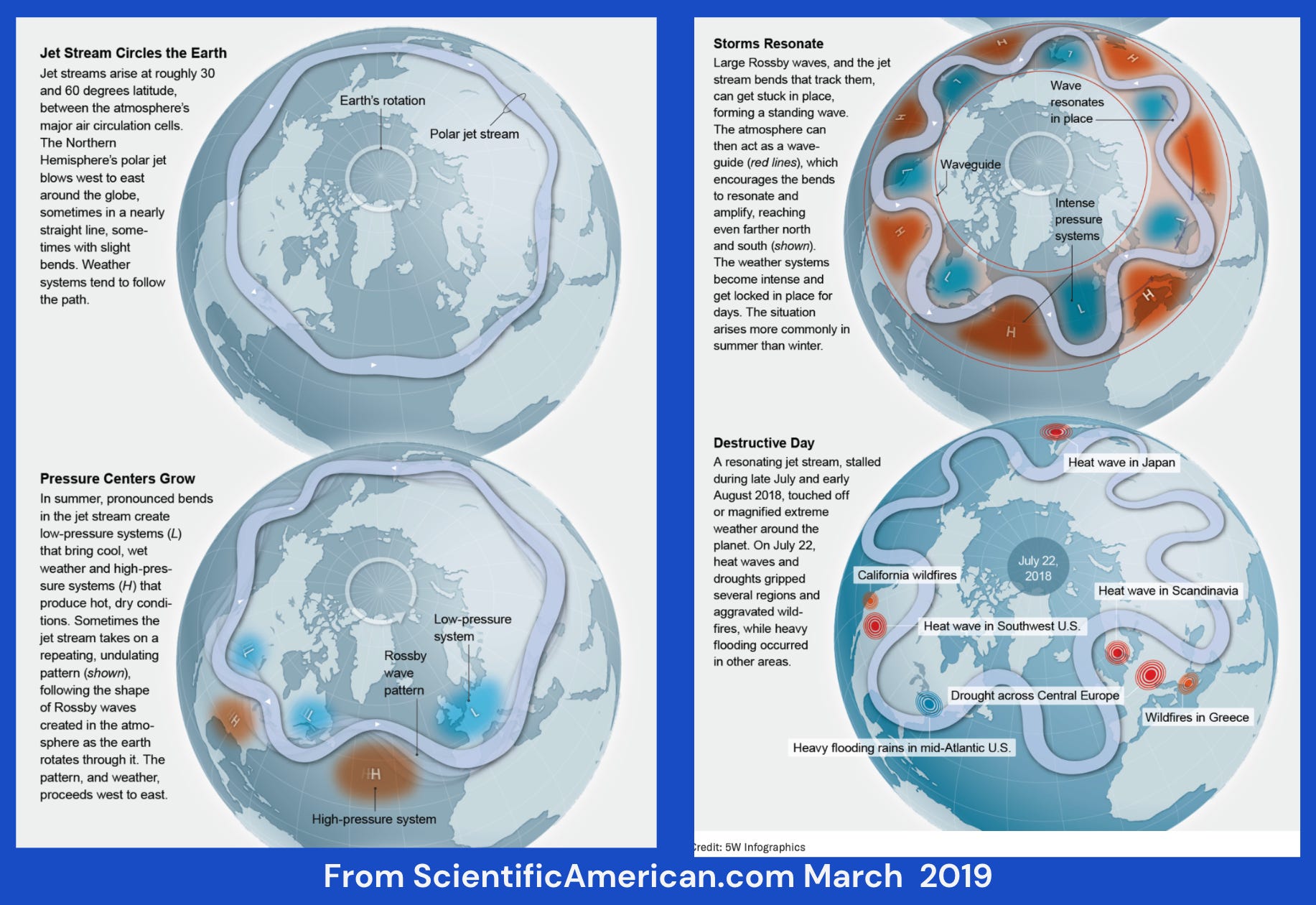
The research paper was mainly focused on understanding this phenomenon and recognising that it was the missing piece of the puzzle in why climate scientists failed to predict that European temperatures would rise more rapidly than the rest of the world. When they re-ran earlier climate models and included this phenomenon, the models gave much more accurate predictions to match the reality we’re now seeing.
Which is not the impression given by the Telegraph headline…
The Telegraph article
So, yes, the prolonged heatwaves and greater increases in temperatures compared to the rest of the world are absolutely impacted by the reduction in air pollution…
But the take-home should not be that removing air pollution CAUSED our heat waves, but that other, more polluted parts of the world aren’t warming up as fast as Europe, because their pollution levels are currently protecting them from the worst impacts.
The increase in global temperatures is driven by man-made climate change, not by removing pollutants from the atmosphere.
Of course the Telegraph knew all of this, despite the headline, as buried deep in the article they included the following paragraph:
The scientists found that while the removal of sulphates made heatwaves more potent in Europe, if their emissions had not been curbed the overall impact of global warming would have been worse.
Despite this clarification, politicians such as Deputy Reform leader Richard Tice, have jumped on this Telegraph headline to tweet:
“Net Stupid Zero is contributing to rising temperatures
Seems scientific consensus has screwed up
Cleaner air = higher temps, not CO2
We have been gaslit and lied to”
Let’s do a mini deep dive into aerosol impacts on the climate, and why he is completely wrong!
Aerosol climate effects
First up, studies have shown that each year millions of people die as a direct consequence of air pollution. One Harvard study showed more than 8 million people worldwide died in 2018 from fossil fuel air pollution causing asthma, respiratory infections, lung cancer, and heart disease.
Cleaning up the air is vital to protect our health.
As for the aerosol aspect, they can actually have a warming or a cooling effect on the environment depending on the type (which is why none of this stuff is straightforward!)
As this NASA article explains:
Volcanoes Make Natural, Cooling Aerosols
Volcanoes emit light-coloured sulfur dioxide, which can stay in the air for a few years and block incoming sunlight to cool the atmosphere.
Mount Pinatubo’s eruption in 1991 cooled the atmosphere by 0.4 to 0.5oC and made 1992 and 1993 the coolest years in the past 35 years.
Air-Pollution Aerosols Also Have a Cooling Effect
Burning fossil fuels releases sulfate particles and sulfur dioxide (SO2), which can reflect sunlight and make the atmosphere cooler, as we discussed earlier.
Soot Is a Dark-Colored Aerosol That Warms the Climate
Soot is made of dark particles of carbon from burning fossil fuels, wood, or other plant matter. These dark particles absorb sunlight and warm the atmosphere.
Soot leads to additional warming when it settles onto snow and ice because it makes the surface darker, which causes faster melting.
So, as you can see, burning fossil fuels produces some particles that cool the climate, while other particles cause it to warm up.
But particles aren’t the only by-product that needs consideration. Because burning fossil fuels also increases greenhouse gas emissions, which have a far greater warming effect on the planet than air pollution has on cooling it.
Aerosol air pollution has made the planet about 0.4°C cooler than it otherwise would be, according to the Intergovernmental Panel on Climate Change (IPCC) 2021 report.
Greenhouse gas emissions, on the other hand, have made the planet 1.5°C warmer than it would be.
As the NASA article concludes:
This makes for an interesting predicament. It might seem that air pollution is oddly helpful to counteract climate change. But that doesn’t mean we need air pollution to keep the world slightly cooler. As people and economies shift to energy forms that emit less particulate pollution, there will be a gradual reduction in air pollution aerosols, which could cause a temporary warming effect.
Over the long haul, reducing emissions of heat-trapping gases will more than make up for any temporary warming. Plus, cleaner air will save millions of lives.
Conclusion
The warming of the planet is not caused by a decrease in air pollutants (that humans added to the atmosphere in the first place!).
It is caused by greenhouse gas emissions.
Air pollution has protected us from the worst impacts so far of global warming, and removing air pollution will remove those protections.
While not tackling the problems caused by fossil fuels could increase air pollution, which will slightly lower temperatures (and kill millions), it will also create far greater warming from the greenhouse gases.
Those who deny or want to downplay man-made climate change are very keen on only ever looking at one side of these kinds of balances.
The take-home today is always read the full article and don’t just read the headline. When media that is ideologically opposed to the idea of man-made climate change runs headlines about climate change or net zero, treat them with an enormous dose of scepticism, and dig a little deeper.
And finally, thank you to Dr Wildschut over on Bluesky for ‘paging’ me when he saw this headline!
I love receiving suggestions of shifty-looking headlines (although I can’t promise to debunk them all!) so keep them coming.
Thank you to everyone who supports me by reading, subscribing and sharing my work. I can’t tackle the tsunami of misinformation out there on my own. You guys sharing my work, or just using it to inform your side of any argument with friends and relatives, makes a difference as we all try to chip away!
Liking and commenting on my post tells Substack that I’m someone people like to engage with, so all interactions are much appreciated!
And a special thank you to everyone who has signed up as a paid subscriber or bought me a coffee. Your financial support means the world.

Oh this is such a good debunk I almost screamed in pleasure! Quite apart from positing the ridiculous Hobson's choice of "Would you like to die from air pollution or an over heated planet?", this nonsensical Telegraph article is essentially just another attempt to deflect attention from, and to rubbish, what is indisputable anthropogenic climate change.
The billions of tonnes of carbon we pump into our atmosphere as a result of burning fossil fuels is warming our planet to the extent that it will soon be the cause of massive human migration, famine, drought and the deaths of probably billions of people and the extinction of 50% of all other known species at 30, 50 and 70 years out from now. The sources for this claim are the UNEP, IPES, IPCC and the Zurich Insurance Group (actuaries rarely get these things wrong).
Richard 'net stupid' Tice is of course entirely unqualified to opine on such matters and as it happens, an utter hypocrite, investing as he does in Green energy. If anyone doubts the effect on climate of CO2 they should watch this series fronted by Chris Packham.
https://www.bbc.co.uk/iplayer/episodes/p0fpwhhm/earth
Excellent article, thanks for sharing.
It is important to note that the quoted IPCC figures for the aerosol masking effect probably underestimate the severity significantly. Combined with James Hanson's latest work on climate sensitivity this means we will probably exceed +3°C by 2050, never mind 2100, which will halve global food production. So that's at least 4 billion people dying of starvation in our lifetimes.
Some scary reading for the technically minded (trigger warning: extinction events discussed):
https://arxiv.org/abs/2211.16115