
How a Countryside Study Became a Culture-War Flashpoint
Following the trail from public policy reports to inflammatory headlines.

Before we start, in case you didn’t open yesterday’s email, I covered most of this in this week’s Bear and Monk Debunk podcast, if you’d like to listen rather than read!
If you’ve been anywhere near any right-leaning news sources this week, you’ll have no doubt seen reports of Britain’s countryside being “too white” or “racist”.
I did a Google news search for the terms “countryside” and “diversity”, and here are 4 days’ worth of news articles covering this story:
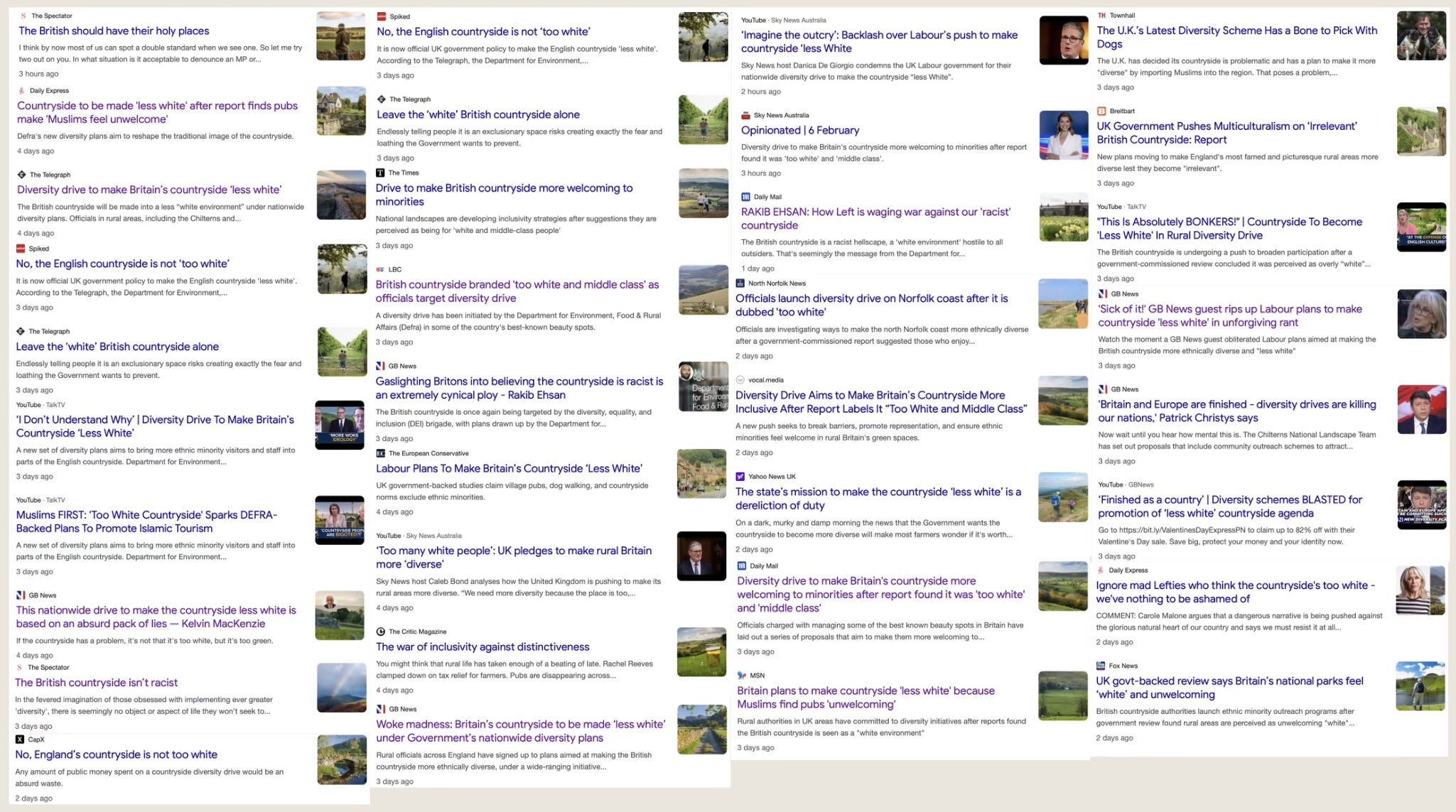
You’d be forgiven for thinking that there was some new explosive report or that Labour had made some policy announcement to warrant this kind of coverage.
But no, this all begins with a Telegraph article…
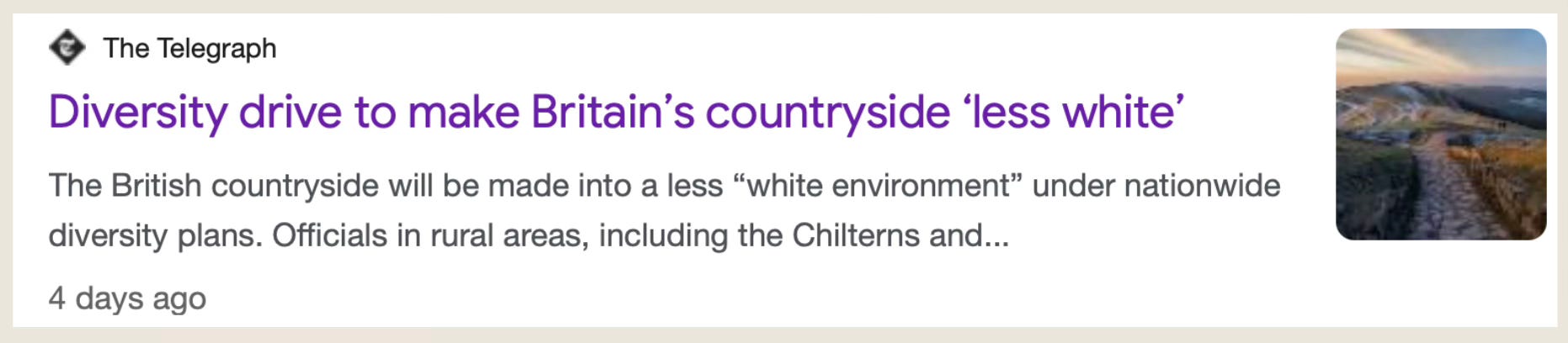
And what prompted the Telegraph article?
Absolutely nothing that I can find. No freshly published report. No Labour Party statement. This is an article that has been pulled together using reports and plans that are months or years old to make a news story that has riled up the Right, not just in the UK but across the world (This has been reported by USA, Australia and European media)
This is one of those debunks/explainers that benefits from a paragraph-by-paragraph look at the article.
But first, a little bit of background on the official reports being covered by this story.
Landscapes Review 2019
This was a wide ranging governement review into British national parks and Areas of Outstanding Natural Beauty that was published in 2019, six years ago.
It was 167 pages long, and covered five key areas:
Landscapes Alive for Nature and Beauty
Landscapes for Everyone
Living in Landscapes
More Special Places
New Ways of Working
The one section of Landscapes for everyone that addressed diversity highlighted:
Children are spending less time unsupervised outside, and children from black, Asian and minority ethnic, and low-income communities are even less likely to do so.
18% of children living in the most deprived areas never visit the natural environment at all.
20% fewer Visibly Minority Ethnic (VME) children go out into green spaces weekly compared to white, middle-class children.
Children from deprived backgrounds visit 10% more than VME children.
The groups which visit the countryside least are those aged 65 and over, members of the black, Asian and minority ethnic population and residents living in the most deprived areas of England.
The composition of the Park governing bodies is:
68% male
99.2% white
Average age 64 (National Parks) and 54 (AONBs)
The report highlighted a multitude of barriers to accessing natural spaces, including: accessibility, transport, cost, lack of facilities and lack of online information.
It also covered many groups of people who would benefit from accessing these spaces more, including: children, those with disabilities, the elderly, people with health conditions, ex-offenders, children in care and addiction sufferers.
But it was the one proposal (of the 27 in the report) that said: “New long-term programmes to increase the ethnic diversity” that kicked off the Telegraph article.
Well, that and a 2022 report for DEFRA (Department of Farming and Rural Affairs) called: “Improving the Ethnic Diversity of Visitors to England’s Protected Landscapes”. As you can imagine, that report did not go down well with the Right-Wing press!
Improving the Ethnic Diversity of Visitors to England’s Protected Landscapes
This was an extensive analysis published in 2022 of who is accessing our natural environments and why certain groups aren’t. They did in-depth interviews and focus groups to get a better understanding of the barriers they face. They found:
42% of minority ethnic groups visited natural environments at least once a week, compared to 69% of white groups.
23% of minority ethnic groups visit less than once a month or never, compared to 14% of white groups.
Despite making up 10% of the population, minority ethnic groups only make up 1% of national park visitors.
So the data from both reports highlight that minority ethnic groups are not visiting National Parks and AONB (now called National Landscapes) in the same proportions as white people, and that the people running these spaces are overwhelmingly older, white, and male.
So there have been suggestions that it might be a good idea to try to address some of the barriers stopping minority ethnic, disabled, and elderly people from benefiting from natural spaces as much as they could.
And that brings us neatly onto the outrage we’ve seen across the Telegraph, GB News, The Express, Talk TV, Spectator, Daily Mail and others.
The Telegraph wrote the first article, and the rest used that as the basis for their own pieces.
The Telegraph article
For clarity, I will use two different styles of quote to differentiate the Telegraph article (centred text between dividers) from the reports they’re referring to (left-aligned with a green bar).
The Telegraph began:
The British countryside will be made into a less “white environment” under nationwide diversity plans.
Officials in rural areas, including the Chilterns and the Cotswolds, have pledged to attract more minorities under plans drawn up by the Department for Environment, Food & Rural Affairs (Defra).
The plans follow Defra-commissioned reports that claimed the countryside would become “irrelevant” in a multicultural society, as it was a “white environment” principally enjoyed by the “white middle class”.
The DEFRA-commissioned reports are the two I have explained above. So let’s take a look at the deliberately inflammatory words and phrases in the scare quotes.
“White environment” and “Irrelevant”
These both come from the same paragraph in the 167-page, 2019 Landscape Review.
Many communities in modern Britain feel that these landscapes hold no relevance for them. The countryside is seen by both black, Asian and minority ethnic groups and white people as very much a ‘white’ environment. If that is true today, then the divide is only going to widen as society changes. Our countryside will end up being irrelevant to the country that actually exists.
Note that the “white environment” idea was held by everyone, including white people. A sentiment that is also borne out by the statistics.
Basically, everyone sees it as a largely white environment, and if we don’t address that, it will remain inaccessible and therefore irrelevant to parts of our population.
But boy, have they managed to twist that into implying that ethnic minorities are somehow insulting our cherished English green and pleasant lands by calling them “irrelevant” and “too white”…
“White middle-class”
Here is the paragraph containing that phrase.
We are all paying for national landscapes through our taxes, and yet sometimes on our visits, it has felt as if National Parks are an exclusive, mainly white, mainly middle‑class club, with rules only members understand and much too little done to encourage first-time visitors.
Again, an observation that is backed up by the data.
Back to the article…
National Landscapes – previously called areas of outstanding natural beauty (AONB) – and their local councils have since committed to a number of diversity targets.
At this point, the Telegraph has clearly trawled as many National Landscape Management plans as possible to try to find any suggestion of “diversity”. And it makes quite an interesting lesson on how they manipulate their audience with what they cover. So we’re going to compare the wording in the article to the actual wording from the management plan for each one
Chilterns
The Chilterns National Landscape team has set out proposals that include community outreach schemes to attract more Muslims to the area, particularly from nearby Luton.
The Chilterns produced a report in March 2024 looking at the Luton and Dunstable area, titled: Co-creating spaces for supporting diverse communities to use greenspaces and the countryside.
It was commissioned to understand why “people from lower socio-economic groups, people from Black, Asian and Minority Ethnic backgrounds, women, the elderly and disabled are less likely to access greenspaces.” and to come up with suggestions on how to make access more equitable.
Having discovered that in their area, “Muslims had the lowest use of greenspaces, which was significantly less than participants who self-identified as Christian, Hindu, or Sikh”, one of the suggestions was to pilot a community outreach program targeting Muslims in Luton and High Wycombe. Which makes sense, right!
More diverse staff will be recruited, marketing material will be produced featuring people visibly from ethnic minorities, and written in “community languages”.
I couldn’t find any reference in the report to more diverse staff being recruited.
As for the “marketing material will be produced featuring people visibly from ethnic minorities?” Here is the relevant section:
“Increase visibility of diverse religious-cultural communities and people with visible disabilities in publicity materials for greenspaces and the Chilterns countryside”
So not “visibly from ethnic minorities” but increase the visibility of diverse communities and those with visible disabilities. It’s a subtle difference, but the language matters!
And again, it’s a good idea if you want to encourage more people to visit.
And what about the “community languages” in scare quotes? Well, yes, again, providing information in community languages seems like quite a good idea. This is what the report said:
“Increase community awareness through sharing information about the Chilterns in accessible community languages/methods”
Back to the Telegraph:
Research has also been commissioned to support this work, some of which suggests that dogs should be kept under tighter control, as some groups are scared of them.
Ah yes, we’re onto dogs and “certain groups” being scared of them. We all know that’s code for “Muslims”. But what did the report actually say?
Some participants, regardless of ethnicity, added that the fear of unleashed dogs was a barrier to people visiting greenspaces and the countryside.
“…we used to spend a lot of time using them [Luton greenspaces], because my son loves planes. We used to go to our local greenspace, it’s not a park, just an open green grass area with lots of trees where you can see the planes landing and taking off. We spent hours there until people come with different dog breeds and one time we were attacked. My son was so terrified that he will not go to this greenspace anymore.” (Polish female)
So yes, some people are scared of dogs. The report (unsurprisingly) found that this was the case regardless of ethnicity, and it was a Polish mother who was quoted in the report.
But the Telegraph reported that as “some groups” are scared of them. Again, it’s subtle, but “some people” is not the same as “some groups”
Now, the Chiltern’s report was specifically about improving access for a more diverse range of people, although not just ethnically diverse, so I can see why the anti-DEI crowd would be all over that. But what follows are single lines or maybe a paragraph pulled from 100+ page reports that cover a multitude of topics associated with rural areas, in an effort to suggest the countryside has somehow gone woke!
Malvern Hills
The Malvern Hills National Landscape Management Plan 2025-2030: Caring for this Area of Outstanding Natural Beauty is a 146-page document, published in March 2025, covering everything from biodiversity and climate change to tourism, farming, volunteering and working within the area. It covers 17 different policies across 322 paragraphs.
This is what the Telegraph covered:
Malvern Hills National Landscape said in proposals: “Many minority peoples have no connection to nature in the UK because their parents and their grandparents did not feel safe enough to take them or had other survival preoccupations.”
It added: “While most white English users value the solitude and contemplative activities which the countryside affords, the tendency for ethnic minority people is to prefer social company (family, friends, schools).”
Guess how many paragraphs in the report mention ethnic minorities?
Two.
So the Telegraph obviously felt the need to cover both, while giving no broader context covering the other 320 paragraphs.
Then they printed:
The area will aim to “develop strategies to reach people or communities with protected characteristics such as people without English as a first language”.
And the report?
“develop strategies to reach people or communities with protected characteristics such as people without English as a first language (includes the Deaf community), people with disabilities, those with cognitive/learning and other hidden disabilities”
Notice what they left out in their effort to pretend these management plans are all about race and ethnicity. For reference, there are 7 paragraphs referencing people with disabilities.
Next up, Nidderdale.
Nidderdale
The Nidderdale National Landscape: An Area of Outstanding Natural Beauty Management Plan is a 29-page plan still in draft form, published in August 2025.
Again, there is one paragraph on inequality:
Looking beyond the National Landscape boundary, surrounding urban areas are home to much more diverse populations considering factors such as age, ethnicity and income. While many people are able to visit Nidderdale if they wish to, a significant number of nearby communities, such as ethnic minority communities or deprived urban areas, face barriers to access. These can be practical issues such as lack of transport and a lack of awareness but may also involve concerns about how they will be received when visiting an unfamiliar place.
And how was this covered in the article?
Nidderdale National Landscape in North Yorkshire warns that ethnic minority counties may face barriers to access, and have “concerns about how they will be received when visiting an unfamiliar place”.
I don’t know what they mean by “ethnic minority counties” - I assume that’s a typo. But the report is talking about both ethnic minorities AND people from deprived urban areas.
The area has stated in its plan that it will “develop more inclusive information to reflect more diverse cultural interpretation of the countryside”.
We can forgive a typo, but this part is simply not true. That quote (and they’ve used quote marks) is not in there. That exact quote is however, in the Kent Downs AONB Enhancing Access Opportunities Report.
Do we think AI might have been used to try to ‘find’ these kinds of quotes? Because the Telegraph doesn’t mention the Kent report at all, but attributes the quote from it to Nidderale…
And it doesn’t get better as they move onto Cranbourne Chase
Cranborne Chase
Cranborne Chase National Landscape, which overlaps Dorset, Wiltshire, Hampshire and Somerset, will “reach people or communities with protected characteristics such as people without English as a first language”
Despite being 162 pages long, the Cranborne Chase National Landscape Partnership Plan 2025-2030 does not contain that quote. And the more eagle-eyed of you might recognise that it is actually the quote from the Malvern Hills report, where the Telegraph cut off the part about the deaf community, people with disabilities, those with cognitive/learning and other hidden disabilities.
The Cranborne Chase report does contain one whole line about diversity in its 162 pages:
Develop strategies to reach people or communities with protected characteristics, such as those with disabilities, diversity of ethnicity and those with cognitive/learning and other hidden disabilities.
Was that another AI issue, assigning the wrong quote to a report with a similar one? Or just sloppy writing and editing? Who knows…
We move on to Surrey Hills. Don’t worry, we’re nearly done with their fishing exercise!
Surrey Hills
The Surrey Hills National Landscape Management Plan (2025 – 2030) was published in November 2025 and is 67 pages long. There is not a single mention of race nor ethnicity. And yet, the Telegraph reports:
The management of Surrey Hills has found that “some demographics are still under-represented in our countryside”
This comes from a paragraph discussing general accessibility:
However, access for other user groups remains patchy, with a fragmented bridleway network and inconsistent rights of access for equestrians, cyclists, and other users. Additionally, many routes remain inaccessible to those with disabilities. While outdoor pursuits are an option for many, some demographics are still under-represented in our countryside. The current social and economic lack of diversity of visitors remains a concern.
And on it goes!
The 78-page, Suffolk and Essex Coast and Heaths National Landscape Plan contains no mention of race or ethnicity, nor does the 127-page Dedham Vale National Landscape and Stour Valley project area Management Plan 2026-2031, but both still get a mention in the article because they have plans to improve accessibility in general.
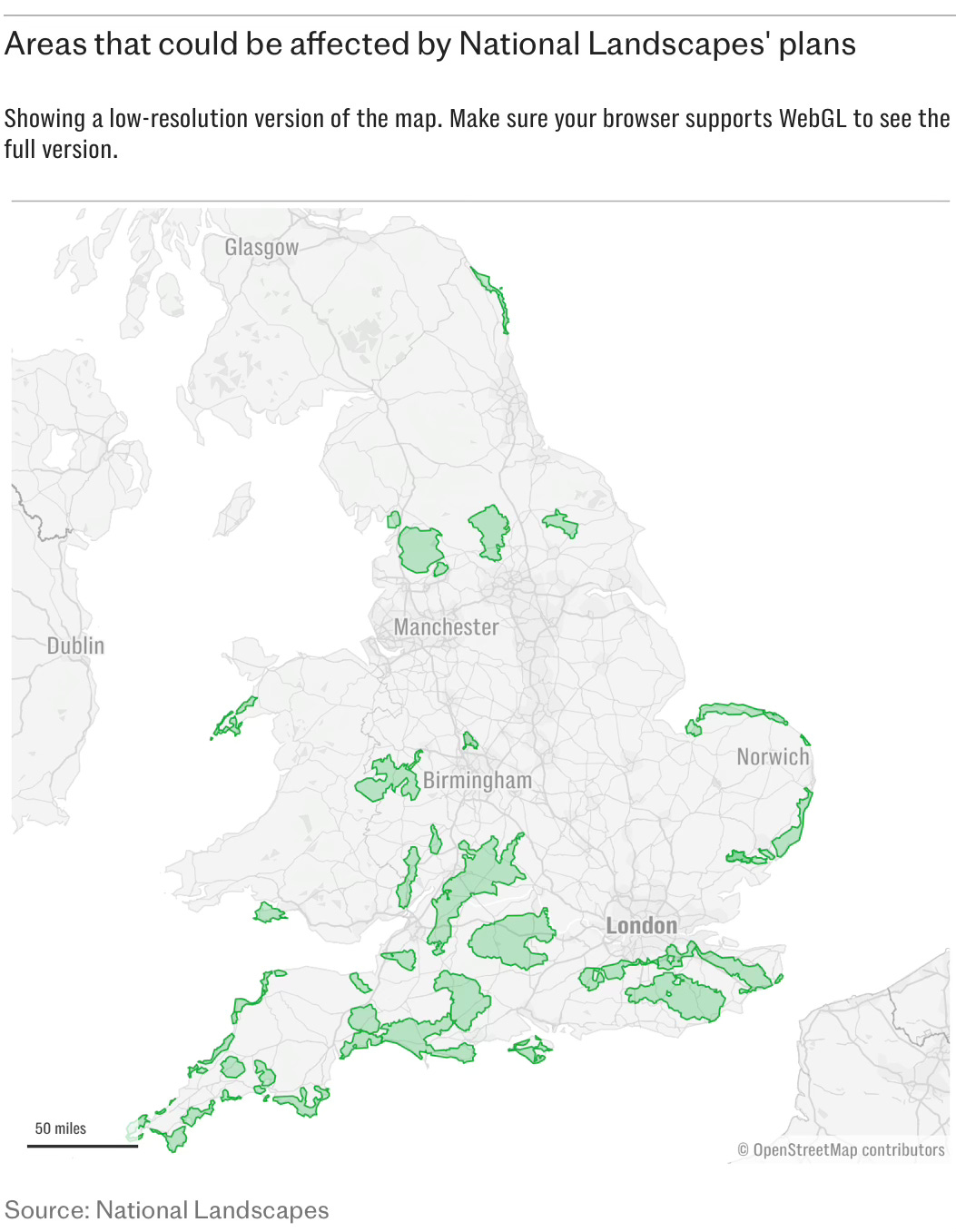
And so we finally reach the end of the section on the “woke” National Landscape plans. The Telegraph provides a handy map of other areas that “could be affected”.
I mean, seriously, “affected” by what? The occasional paragraph suggesting that attracting people that curently struggle to access these spaces might be worth a try?
The 2022 Diversity Report
The article then moved on to the report about improving the diversity of the countryside, which I covered earlier.
Defra commissioned a second report for £108,000, titled “Improving the ethnic diversity of visitors to England’s protected landscapes”, which in 2022 found that “perceptions of protected landscapes as being for white people and middle-class people could be a powerful barrier for first-generation immigrants”.
That makes it sound like that was the conclusion of the report, as opposed to one line in section 4.1.2 on page 27 of the 94-page report. The sentence was truncated by the Telegraph and actually read:
Perceptions of protected landscapes as being for White people and middle-class people could be a powerful barrier for first-generation immigrants who had been made to feel unwelcome in other settings.
It followed a case study of a woman whose parents belonged to the Windrush generation:
“I was brought up thinking that these spaces were for the, well, my mum would have said, ‘For English people.’ Not that I’m not English because I was born here, but a white English person, and maybe middle-class […my parents] were very wary of being around people generally because of the experiences that they had, the negative experiences, which are valid”
You can see why that would impact your relationship with the countryside.
The research showed that ethnic minorities believe visiting landscapes and was associated with “white culture”, and see “the English countryside as a white space, to which they did not belong”.
The first quote was about a very specific group within the report - those who expressed no interest in visiting protected landscapes. This was not ethnic minorities in general, as suggested by that sentence.
Participants sometimes couched their lack of interest in the language of ‘culture’. The implication was that visiting landscapes and the associated activities were part of White culture.
The second was a more widely held view
For participants who did feel motivated to visit landscapes, some were held back by concerns about being treated badly, being outnumbered or out of place, or being unsafe. For ‘visible’ minorities, feeling unwelcome was sometimes explicitly or implicitly attributed to the idea of the English countryside as a White space, to which they did not belong.
As expressed by one respondent:
“If there’s literally no black people - don’t get me wrong, we let it go over our head - but I do feel a bit uncomfortable, because I just think why? It’s like, are we really accepted in these sort of places? Are these places really for black people?” Interview, Black and Black British, User
And then the Telegraph moves onto a section that really, really took off in right-wing spaces. They offended our pubs!!
One concern was that rural facilities “cater to white English culture”, namely: “Protected landscapes were closely associated with ‘traditional’ pubs, which have limited food options and cater to people who have a drinking culture. Accordingly, Muslims from the Pakistani and Bangladeshi group said this contributed to a feeling of being unwelcome.”
They have pulled the whole paragraph from the report. One paragraph in section 4.3.1 on page 28
Facilities cater to White English culture. Protected landscapes were closely associated with ‘traditional’ pubs, which have limited food options and cater to people who have a drinking culture. Accordingly, Muslims from the Pakistani and Bangladeshi group said this contributed to a feeling of being unwelcome.
The report goes on to cover food in general in pubs, cafes, food fairs, etc.
However, a lack of food options that catered to cultural or dietary requirements also contributed to a sense of ‘not belonging’ and reinforced other sources of feeling ‘out of place’.
“If they’re not catering to me in terms of my diet and stuff, it doesn’t really feel very welcoming also” Focus group, Pakistani and Bangladeshi, Both users and non-users
There’s no suggestion that pubs are a problem per se; it was simply the practical aspect of them generally not serving Halal food, and therefore Muslims being unable to eat there. So, of course, they feel like they’re not welcome there.
And we finally reach the end of this awful, provocative, possibly AI researched, rage-baity article with:
The Government set out its own ambitions for access to the countryside in 2025.
A Defra spokesman said at the time: “We will work with government, public bodies, businesses, civil society and communities to support people engaging with nature in their own ways and encourage them to do this safely and appropriately through continued promotion of the countryside code.
“We want to equip communities with the resources, knowledge and skills so they can respond to societal and environmental issues in their neighbourhoods.”
This refers to the government’s December 2025 Environmental Improvement Plan, a 151-page document with 91 goals, across 5 chapters, which mentions unequal access to nature a grand total of 3 times, and covering disabilities, low-income households and ethnic minorities each time.
Why does this matter?
The irony with the coverage is that it was basically an even split between “how dare ethnic minorities claim the countryside is too white or unwelcoming, the ungrateful so and so’s” alongside “leave our countryside alone” pieces, which nicely highlight why some minority ethnic people feel the way they do!
Off the back of the Telegraph article, The Spectator published two articles within 24 hours: “The British Countryside isn’t racist” and “The British should have their Holy places” which was a whole piece about how diversity should not be encouraged in the countryside with choice lines like “why should the Indian subcontinent or Africa not be forced to diversify by bringing in a lot of white people from Wales?” (Give me strength!)
Needless to say, the entire right-wing ecosphere lost its collective mind over the Telegraph article, without a single one of them bothering to read any of the actual sources.
Claims about Muslims wanting dogs banned sprung up again (remember the report was quoting a Polish mum whose child was scared of being bitten), and the Express ran with “Countryside to be made ‘less white’ after report finds pubs make ‘Muslims feel unwelcome’”.
I won’t go into these; you get the picture.
Sensible, fairly dry reports, written several years ago, suggest that some groups are facing barriers to accessing nature and that maybe we could try to make those spaces feel more accessible. The Telegraph decides to dig them out and write a deliberately provocative article about diversity, and 35 right-wing media pieces are produced over 4 days, yelling “stop calling us racist” alongside “we like our white countryside”.
This is the very definition of rage-baiting.
Thank you to everyone who reads, shares and subscribes to my Substack.
I am, of course, especially grateful to those who chose to support me with a paid subscription or through coffee donations. Having a small financial income for this work makes a huge difference.
This is another well-reasoned piece from you Emma. It sounds to me as if the Telegraph is searching for common ground with the dreadful ‘restore trust’ organisation who try and thus far thankfully fail to undermine the National Trust.
Sowing the bad seed of division is standard far-right practice.
Thanks again Emma for more painstaking & scholarly research. The subjects that provoke manufactured outrage may vary but the bile & bigotry are constant & your ongoing campaign to identify the techniques & call out the perpetrators gets more vital every day.
As well as being small minded & malevolent they are well organised, well funded, strategic & patient & the effect on the majority who don’t follow politics & propaganda closely can be seen all around us all the time on social media.
Keep up the great work.
Driver Andy